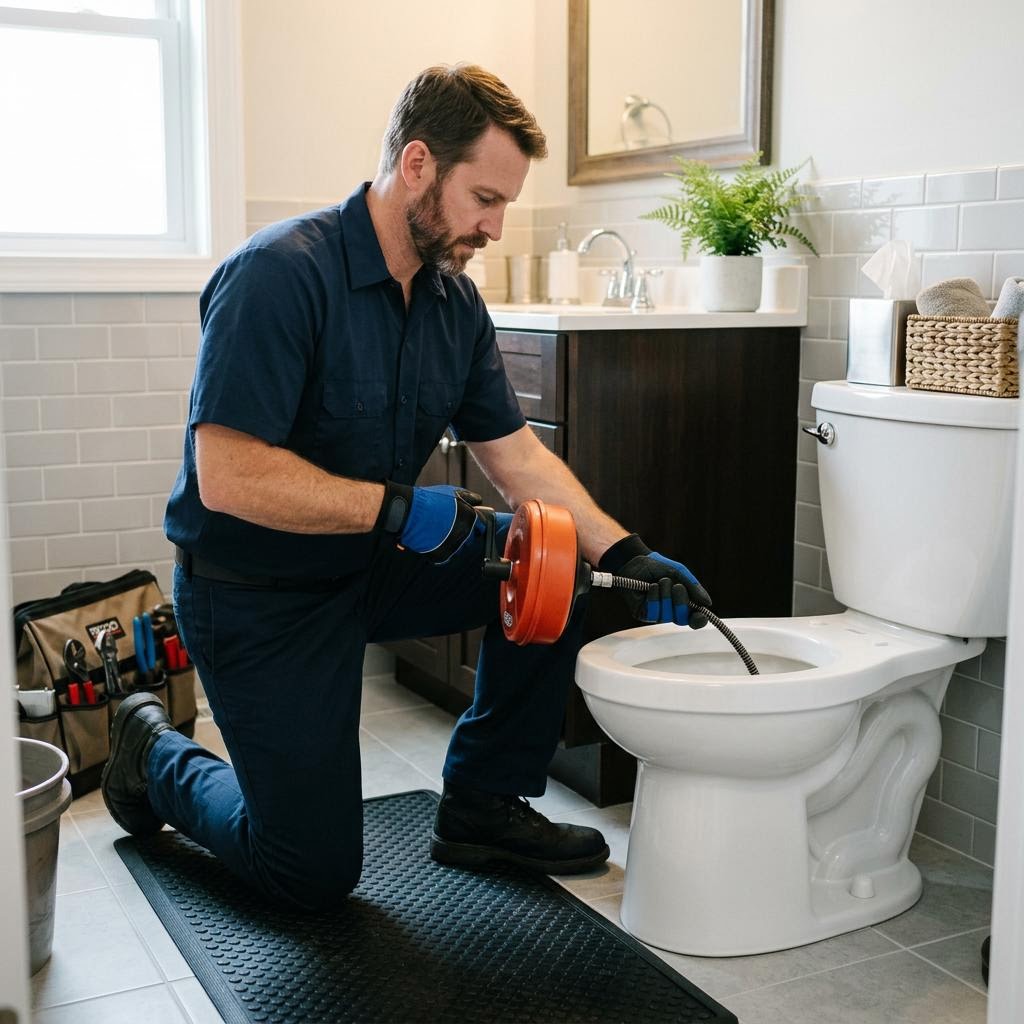
The Problem vs. The Solution
The Problem
Issues related to clogged toilets can cause major disruptions if left untreated.
Our Solution
Our expert technicians rapidly diagnose and fix the issue, restoring proper function immediately.
Our Professional Process
Assessment
Thorough evaluation of the problem area.
Execution
Applying targeted solutions with professional equipment.
Verification
Testing to ensure the issue is completely resolved.
More Than a Plunger Problem
Almost every household deals with the occasional toilet clog, and a good plunger clears most of them. But a toilet that clogs repeatedly, drains slowly even when it does clear, or backs up alongside other fixtures is telling you about a problem beyond the bowl. Learning to read that difference saves both frustration and money.
A toilet is simply the most visible entry point to your drainage system, so it is often where deeper trouble first appears. When the clog is not really in the toilet at all but downstream in a branch or the main line, plunging will feel like a losing battle because you are treating the wrong location.
It also helps to understand the toilet's own weak point. Inside every toilet is a narrow S-shaped trapway moulded into the porcelain, and it is the tightest passage anything must clear on its way out. Most true toilet clogs lodge right there. Over years, hard-water scale can also build up inside that trapway, narrowing it and making the toilet progressively less able to clear a normal flush. A toilet that has slowly gotten worse over a long time, rather than clogging suddenly, is often suffering from that internal scaling.
What Actually Causes Toilet Clogs
The overwhelming majority of stubborn toilet clogs trace back to what gets flushed. Modern low-flow toilets use less water per flush, which is excellent for conservation but less forgiving of anything bulky or fibrous. Products marketed as flushable are a frequent culprit because they do not disintegrate like toilet paper does.
- Flushable wipes, paper towels, and facial tissue that do not break down
- Excessive toilet paper in a single flush, especially with low-flow models
- Feminine hygiene products and cotton items
- Toys and objects flushed by young children
- Hard-water scale narrowing the internal trapway over time
Clearing a Clog Without Making It Worse
When a toilet clogs, resist the urge to flush again in hope; a second flush on a blocked bowl is how overflows happen. Instead, let the water level settle, then use a proper flange plunger that seals the bowl outlet. A toilet auger, or closet auger, is the next step and is designed to reach through the trapway without scratching the porcelain.
Avoid chemical drain cleaners in a toilet. They are ineffective against most physical obstructions, and if the clog does not clear you are left with a bowl of caustic water to deal with. If a plunger and auger do not resolve it, the blockage is likely past the toilet and needs professional equipment.
When Several Fixtures Point to the Main Line
Here is a warning sign worth memorizing: if flushing the toilet makes water gurgle in the tub or a nearby drain slows down, the problem is not the toilet. Those symptoms mean air and water are backing up through a shared line, which points to a clog in the branch or main sewer.
In older Ottawa homes this pattern frequently traces to root intrusion or grease and scale in an aging lateral. A downstairs toilet that backs up when the washing machine drains is a classic main-line symptom. This is exactly the situation where a camera inspection earns its keep, revealing whether you are facing roots, a belly, or a failing section of pipe.
Seasonal timing can be a clue as well. If your toilet troubles tend to flare up in spring, when snowmelt and freshet raise water levels in the municipal system, or during heavy summer storms, the issue may be less about what you flush and more about the sewer being under pressure. Homes in older parts of the city served by combined sewers are more exposed to this. Noticing when the problem appears, not just how it appears, gives a technician a valuable head start on the diagnosis.
Prevention That Actually Works
Keeping toilets clear is mostly about discipline over what enters them. Treat the toilet as a fixture for human waste and toilet paper only, and keep a small bin in the bathroom for everything else. It is a simple rule that prevents the majority of repeat clogs.
In hard-water homes, occasional professional cleaning also helps by removing scale that quietly narrows the trapway. If you have young children, a lidded toilet and a quick conversation go a long way. And when a toilet clogs more than occasionally, treat it as a signal to look further down the line rather than a one-off.
There is also a case for the toilet itself when clogs never seem to end. Very early low-flow models, common in some Ottawa homes from the first generation of water-saving fixtures, were notorious for weak flushes that struggled to clear the trapway. Modern high-efficiency toilets move waste far more effectively on less water. If a particular toilet has fought you for years despite good habits and a clear line, the fixture may simply be the weak link, and replacing it can end a long-running frustration.
Getting to the Root of Repeat Clogs
A toilet that clogs again and again is not bad luck; it is a symptom. Whether the cause is a partial main-line obstruction, root intrusion, or a fixture problem, the fix starts with correctly locating the blockage rather than repeatedly plunging the same bowl.
Before you reach that point, a couple of habits genuinely help. Keeping a quality flange plunger and an inexpensive closet auger on hand lets you resolve the ordinary clogs yourself without resorting to chemicals or a second hopeful flush. And paying attention to whether a clog is truly isolated to one toilet, or part of a wider pattern of gurgles and slow drains, tells you immediately whether you are facing a simple fixture issue or something in the shared line.
If your toilet keeps backing up, or if flushing triggers gurgling elsewhere in the house, it is time for a proper diagnosis. Call Ottawa Drain Cleaning at (613) 706-2303 and we will find out where the real problem sits and clear it for good.
Frequently Asked Questions
Ready to schedule clogged toilets?
Call now for immediate service or book online for a scheduled appointment.